Launch pad
In contrast to military rockets and larger rockets that carry astronauts Stella 1 is passively stabilized, meaning that vertical flight is assured with fixed fins. These become effective only at certain velocity, that is why Read more…
In contrast to military rockets and larger rockets that carry astronauts Stella 1 is passively stabilized, meaning that vertical flight is assured with fixed fins. These become effective only at certain velocity, that is why Read more…
We recently renovated our lab in Katapult accelerator, which will allow us to start building the Stella 1 rocket. In addition to new electric and hand tools, we have also fabricated a clean room for Read more…
In May, after weeks of preparations and never ending second thoughts, whether we forgot something, we managed to fire up the SL-1. We decided to schedule the test in the evening, when the flame would Read more…
Small-scale hybrid rocket motor tests. The aim was to demonstrate hybrid technology and develop of a reliable igniter for larger motors. We used gaseous oxygen as an oxidizer and acrylic glass as fuel.
SL-1 was Spacelink’s first rocket motor with paraffin-based fuel and liquid oxygen as an oxidizer. It generated a thrust of 2 kN during its 10 seconds of operation.
SL-2 is the flight-ready motor, prepared for use in the Stella 1 rocket. It generates 4 kN of thrust during 19 seconds of operation and consumes 30 kg of fuel and oxidizer. Oxidizer is supplied to the combustion chamber with high-pressure helium.
Stella 1 will be Spacelink’s first rocket, which will be propelled by the SL-2 motor and will reach an altitude of 10 km. It will be equipped with a two-stage recovery system, consisting of a drogue and a main parachute.
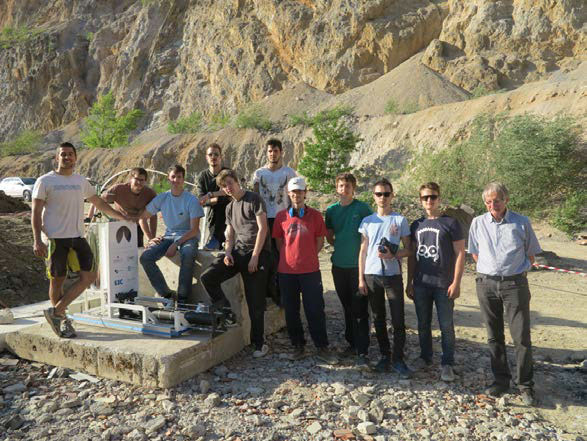
Spacelink Institute is a team of young, innovative engineers who aspire to develop a space program in Slovenia. Our team is building a rocket that will be launched above the Karman line, which lies at an altitude of 100 km and represents the boundary between Earth’s atmosphere and outer space.
Humans have been placing artificial satellites in Earth orbit for about 60 years with a purpose of earth observation, communication and navigation.
There has been a lot of development effort in miniaturizing satellite technology, resulting in the increasing production of micro- and nanosatellites. These range from under 1kg to a few hundred kilograms in mass.
Currently, transport to orbit is achieved with large rockets, which allows very little flexibility with the final orbit, launch frequency and schedule.
In Spacelink we believe we can differentiate by developing small-in-size and high-performance rockets based on hybrid rocket propulsion to change the way payload is launched into orbit.
Management


Propulsion


Construction

Electronics and advisory